
CITY OF FERNDALE RESOURCES:
Sidewalk Inspections and Replacement Program
The City of Ferndale uses a recurring biennial Sidewalk Replacement Program to maintain safe pedestrian access throughout the community. On even numbered years, the DPW identifies sidewalk flags that are broken, deteriorated, uneven, or otherwise non-compliant and coordinates replacement through a district-based construction process. This program is intended to improve safety, maintain walkability, and complete sidewalk work efficiently across larger areas of the City.
Why the Program Exists
Sidewalks are public infrastructure, but City ordinance and policy generally make the adjacent property owner responsible for maintaining the sidewalk next to their property. The City uses a district-based program because replacing sidewalks on a property-by-property basis is less efficient and more expensive for residents. Grouping work by district lets the City inspect larger areas, bid competitively, coordinate construction, and achieve economies of scale. The program also helps ensure consistent evaluation of sidewalk conditions across the district.
District Rotation
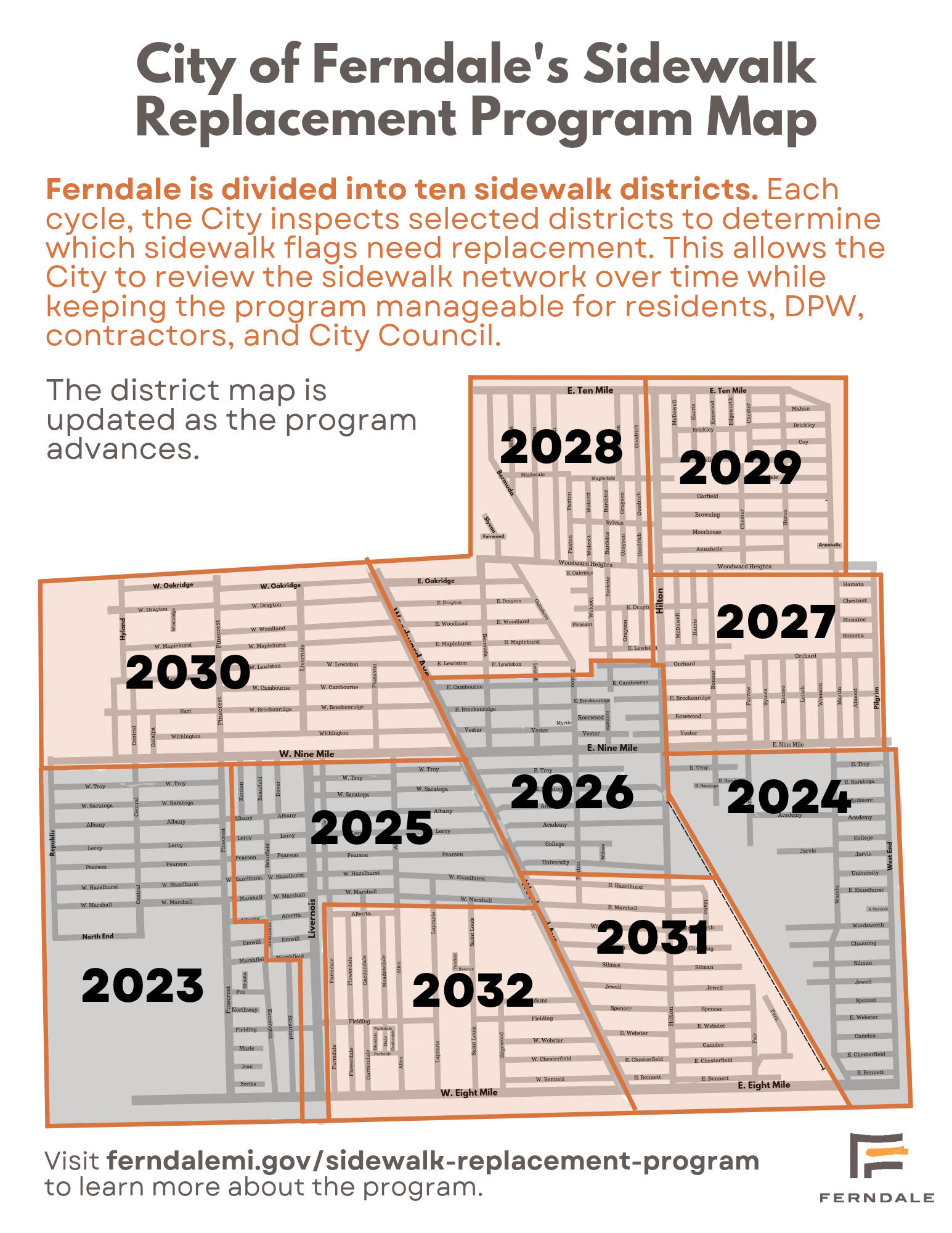
Ferndale is divided into ten sidewalk districts. Each cycle, the City inspects selected districts to determine which sidewalk flags need replacement. This allows the City to review the sidewalk network over time while keeping the program manageable for residents, DPW, contractors, and City Council. The district map is updated as the program advances.
Inspection Process
DPW inspects sidewalks within the selected district. Sidewalk flags are reviewed for defects and non-compliant conditions. Sidewalk panels identified for replacement are typically marked in the field.
The City uses inspection criteria to determine whether sidewalk replacement is required. Common reasons for replacement include:
- Stubbers or vertical separation: Two adjacent sidewalk flags with a vertical separation greater than one-half inch.
- Cracks: A broken sidewalk flag with a single crack or multiple cracks.
- Drainage issue: A sidewalk flag that has sunken and collects water over more than 25% of the flag. This also includes driveway sidewalk flags that have sunk below the height of the driveway approach.
- Holes or pitting: Missing concrete greater than two inches in any direction, severe pitting over more than 25% of the flag, or deteriorated control joints creating a crevasse greater than two inches wide.
- Scaling: Flaking or peeling away of more than 25% of the surface mortar, resulting in a gravel-like surface.
- Excessive slope: A sidewalk flag with a side slope greater than 3 inches per 5 feet, or more than 1 inch per foot along the travel path.
- Other hazardous or deteriorated conditions: A non-typical condition where the inspector identifies a hazard or deterioration, such as mortar creating a trip hazard, asphalt patching, or another unsafe condition.
Public Hearing and Notification Process
In early spring, property owners are notified if they must replace sidewalk adjacent to their property.
The notice typically includes:
- A description of the required replacement
- Estimated quantities
- Estimated cost
- Information about the public hearing
- Instructions for contesting or asking questions about the proposed replacement
- Information about hardship consideration, when applicable
The City Council holds a Public Hearing to establish the Special Assessment District and hear resident comments or objections, typically in May. Residents who cannot attend the Public Hearing may submit written comments to the City Clerk by the deadline provided in the notice.
Horizontal Sawcutting
In some cases, smaller eligible trip hazards may be corrected through horizontal sawcutting instead of full replacement. Sawcutting may be used where the vertical separation is small and there are no other defects requiring replacement. If a sidewalk flag is cracked, deteriorated, sunken, pitted, or otherwise damaged beyond repair, replacement is required.
Contractor Selection and Construction
The City competitively bids the sidewalk replacement work through a formal bid process. A contractor is selected based on the bid results and City review. The contractor performs the sidewalk replacement work using unit prices established through the bid. Final payment is based on actual field measurements.
During Construction:
- Existing sidewalk sections are removed
- Replacement concrete is poured
- Temporary access disruptions may occur
- Residents should avoid newly poured concrete until it has cured
The City works to complete the project efficiently and minimize disruption within the district.
Cost and Special Assessment District
Sidewalk replacement is funded through a Special Assessment District. Property owners are responsible for the cost of sidewalk replacement adjacent to their property. Costs are based on actual measurements and the unit prices from the awarded contract.
Typical sidewalk thickness varies by use:
- 4-inch sidewalk is typically used for standard residential sidewalk
- 6-inch sidewalk is typically used through residential driveway areas
- 8-inch sidewalk may be required for commercial driveway areas or heavier vehicle use
In the 2026 program, pricing for these sidewalks was approximately:
-
$208.25 per 4-inch sidewalk flag
-
$233.25 per 6-inch sidewalk flag
-
$425.00 per 8-inch sidewalk flag
-
$152.81 per sawcuttting
Final assessment amounts may differ from initial estimates because final costs are based on actual field measurements completed during construction.
City Responsibility
The City pays for certain sidewalk work that serves a broader community purpose, including:
- ADA ramps at corner properties
- Detectable warning surfaces
- Sidewalks adjacent to City-owned property
ADA ramps and curb-related accessibility improvements provide a community-wide public access benefit and are not simply individual property frontage maintenance.
Trees and Sidewalks
Tree roots may contribute to sidewalk movement or lifting. The City does not require tree removal as part of the sidewalk replacement program. Where sidewalk work is needed near trees, the City works to complete the sidewalk repair while preserving the tree canopy whenever possible.
Payment and Billing
After construction is complete, the City calculates final quantities and mails final assessment amounts to affected property owners. The assessment is typically billed as a lump sum. If the assessment is not paid, the City may place the unpaid amount on the property tax roll in accordance with City procedures. Property owners selling a property before final billing should disclose the pending assessment to the buyer.
Hardship Consideration:
Residents or property owners who may have difficulty paying the assessment are encouraged to apply for the Sidewalk Hardship Assistance Program. The City can provide funding assistance to those who meet the income requirements:
- Income eligibility extends through the applicable Low Income, or 80% AMI, limit.
- Residential corner-lot owners may also apply, regardless of income, when at least $600 of the assessment is attributable to side-street frontage.
- The City generally intends to provide up to 100% assistance for Extremely Low Income applicants and up to 50% for other approved applicants. Greater assistance may be available if funding allows.
Residents who do not meet these thresholds but believe the assessment creates a hardship may still request consideration. The hardship process typically occurs after final cost letters are mailed, following the construction, in the fall.
Appeals and Questions
Residents may contact DPW to ask questions about inspection results, replacement requirements, or program timing. Residents may also attend the public hearing or submit written comments if they wish to contest the replacement requirement or discuss concerns before Council action.
Frequently Asked Questions
Please review the frequently asked questions for additional information.
Sidewalk replacement identified through the district program is required. The City coordinates work through the Special Assessment District process to maintain consistency and safety across the district.
District inspections allow the City to review sidewalks consistently, group work efficiently, and obtain better pricing through a larger construction contract.
Sidewalk replacement is coordinated through a City-managed contract to ensure consistency, quality, and efficiency across the district. Property owners with questions should contact DPW.
Your sidewalk was inspected and found to meet one or more of the City’s replacement criteria, such as cracking, vertical separation, pitting, drainage issues, slope, or another safety-related defect.
Initial letters are based on estimated quantities. Final bills are based on actual field measurements completed during construction.
ADA ramps, curb ramps, and detectable warning surfaces serve a broader public accessibility function. These improvements benefit the community as a whole.
Contact DPW to discuss your inspection results. You may also attend the public hearing or submit written comments by the stated deadline.
No. Patching is not an acceptable alternative when a sidewalk is deteriorated or damaged beyond repair.
Contact the DPW front desk for questions about the Sidewalk Replacement Program.
Costs are based on actual measurements of sidewalk replaced and the unit prices established through the awarded contract.