
February 04 2026
Water Bill Update
THURSDAY, FEBRUARY 5, 2026, UPDATE:
During the most recent Section 1 billing cycle, a manual entry error resulted in an incorrect condition being applied to the entire cycle. This resulted in nearly all bills being estimated. Our standard operating procedures reflect the protocol that should have been followed in this case, and corrective action has been addressed. Residents who would like to receive an actual bill instead of an estimated bill can do so by emailing waterbilling@ferndalemi.gov.
We are also working diligently to update our website to include more comprehensive, helpful content.
We sincerely appreciate your patience and understanding as we work to continue serving you as best we can.
---
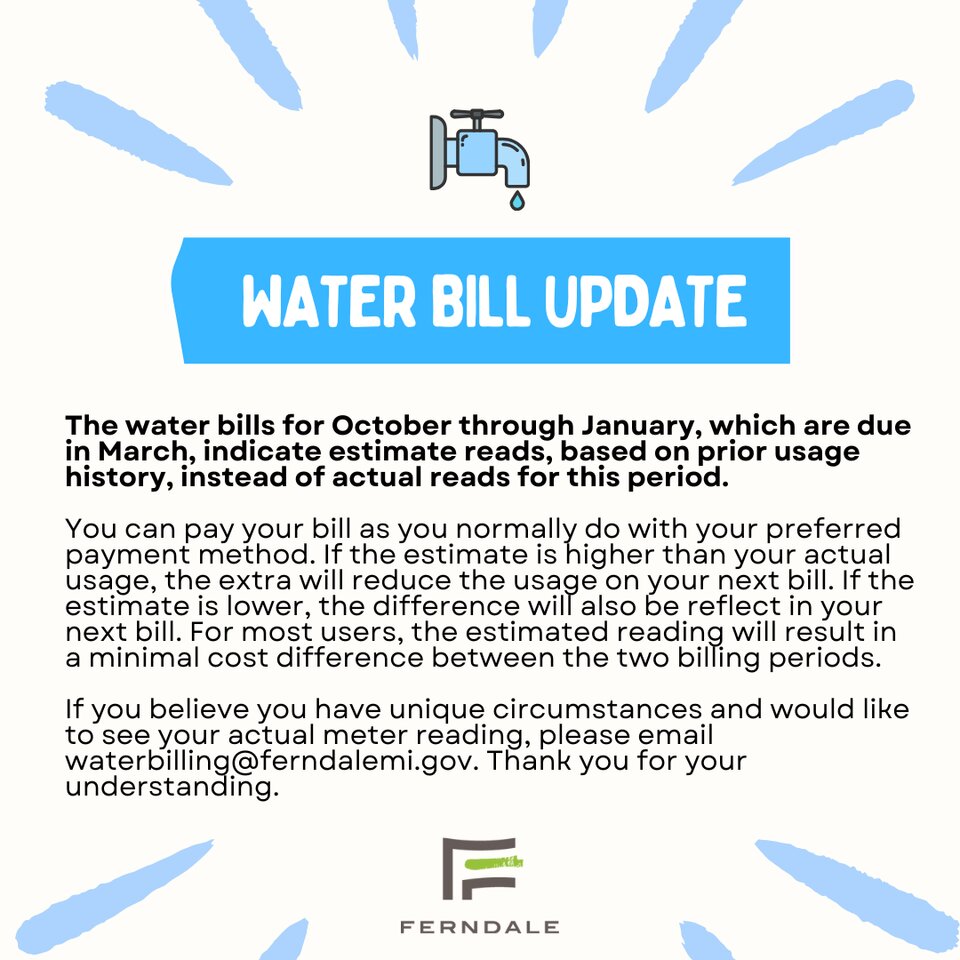
The water bills for October through January, which are due in March, indicate estimate reads, based on prior usage history, instead of actual reads for this period.
You can pay your bill as you normally do with your preferred payment method. If the estimate is higher than your actual usage, the extra will reduce the usage on your next bill. If the estimate is lower, the difference will also be reflect in your next bill. For most users, the estimated reading will result in a minimal cost difference between the two billing periods.
If you believe you have unique circumstances and would like to see your actual meter reading, please email waterbilling@ferndalemi.gov. Thank you for your understanding.
FREQUENTLY ASKED QUESTIONS:
What is GLWA?
The Great Lakes Water Authority (GLWA) is a regional solution for water distribution and wastewater collection. Nearly 40% of Michigan’s population is served by GLWA water, and 30% by GLWA wastewater services. Ferndale is one of many participating member communities. You can learn about the authority here: https://www.glwater.org/about/what-is-glwa/.
How are bills calculated?
Utility bills are broken down into three categories:
- readiness to serve fee
- water usage
- wastewater usage
The readiness-to-serve fee is a fixed cost based on the system's recurring capital needs, while usage fees are charged based on the volume of water and sewer treated per cycle.
What is the readiness-to-serve fee?
The readiness-to-serve fee is the fixed-rate cost for managing and maintaining the distribution and collection systems. The fee covers the cost of maintaining a system that is “ready to serve” your home or business at any time, regardless of your consumption needs.
This includes the infrastructure required to deliver water or collect wastewater from your home or business. These are fixed assets with a set lifecycle that require regular maintenance, repairs, or replacement. The charge is based on your meter size; larger meters incur a higher fee. The current readiness-to-serve charge is $10 per month or $30 per quarter for small residential meter sizes.
What are usage charges?
The rates for water usage are determined by calculating the difference between the meter read at the end of your last billing period and the meter reading at the end of the current billing period. Usage is calculated in cubic feet of consumption, with one unit equaling 100 cubic feet of water or 748 gallons.
As of February 2026, the water usage rate is $6.292 per unit, and the sewer usage rate is $11.059 per unit, for a combined fee of $17.351. Rates are adjusted annually, and new rates take effect on July 1 of each year.
Why is my bill high?
In addition to the fixed costs, the City of Ferndale determines additional capital needs, and thus fees, based on our Capital Improvement Plan and assessment management plans. By law, fees must only be used to fund the system in its current capacity with a reasonable reserve fund balance for unplanned expenditures or capital cost overruns. The City cannot create reserves or savings for future projects or generate profits like a private business operation would.
The City of Ferndale bills quarterly, with each cycle covering three months of usage. Usage varies depending on factors such as personal habits, the number of individuals using the home, and the efficiency of the appliances. The City offers solutions for residents to monitor their water usage and access historical usage data to help control household costs.
Where are the fees I pay going?
As a member of GLWA, a large portion of costs for the system are fixed based on the rates set by the authority and other fixed cost services. GLWA rates are approved by an appointed board of directors. For Fiscal Year 2025 fixed costs accounted for approximately 52% of total Water/Sewer Fund expenditures. GLWA operates the facilities that source water, treat water, and transmit it to local units. Similarly, they operate the systems that receive wastewater transmission, treat the wastewater, and safely discharge clean water back into waterways. The process for wastewater treatment is considerably more complex and costly than water treatment, which is often reflected in higher sewer usage fees. The City does not add any upcharge or additional fees on top of the wholesale water or sewer treatment fees for this portion of the costs.
The remaining costs of the system cover local operations including staff, maintenance, repair, and capital projects directly associated with the City owned portion of infrastructure. This includes activities like hydrant flushing, jetting and cleaning, main lining projects, main replacement projects, emergency water main break response, and lead service line verification and replacement efforts.
Why would a bill be estimated when we have water meters? Can I always ask to have an actual reading?
The default status for generating bills is to do so based on actual reads. From time to time, device communication issues may prevent the remote meter read for a property from being picked up. If the meter cannot connect to our system, an estimated read may be generated. Estimated reads are based on past usage history. The estimate may be skewed if you have inconsistent usage or a recent high-usage event, such as a leak or filling a swimming pool. Residents do not typically need to make any special request to receive a bill based on actual usage; whenever feasible, that is the default process.
However, during the most recent Section 1 billing cycle, a manual entry error caused an incorrect setting to be applied to the entire cycle. This resulted in nearly all bills being estimated. This issue has been corrected for future cycles, and residents who would like to receive an actual bill instead of an estimate can do so by emailing waterbilling@ferndalemi.gov.
How does WaterSmart work?
Please note the City is moving away from WaterSmart as a third-party solution. When smart meters were installed, the manufacturer did not have its own resident-focused solution. They now offer that software, and the City is transitioning to that fully integrated solution. We expect to communicate more details about the process in late Spring 2026.
For more questions, please email waterbilling@ferndalemi.gov.
Share:


